



















PE pipe welding parameters - temperature, time and pressure
Butt welding process for PE pipes
Butt welding is one of the most commonly used methods of joining polyethylene pipelines. The method involves heating the ends of two parts to the material's plasticising temperature and then bringing them together under appropriate pressure. As a result of this action, the material of the two parts fuses and forms a uniform structure.
In practice, the execution of such a joint requires the observance of a specific sequence of technological operations. The preparation of the components, their heating and subsequent assembly determine the course of the entire operation and the quality of the resulting joint. A typical procedure used for butt welding includes the following steps:
- fitting the pipes in the welding machine brackets
- end milling to obtain even surfaces
- checking the alignment of the components
- heating of pipe ends using a hotplate
- Removal of the hotplate and juxtaposition of the elements under pressure
- cooling of the joint in the welding machine
Hotplate temperature
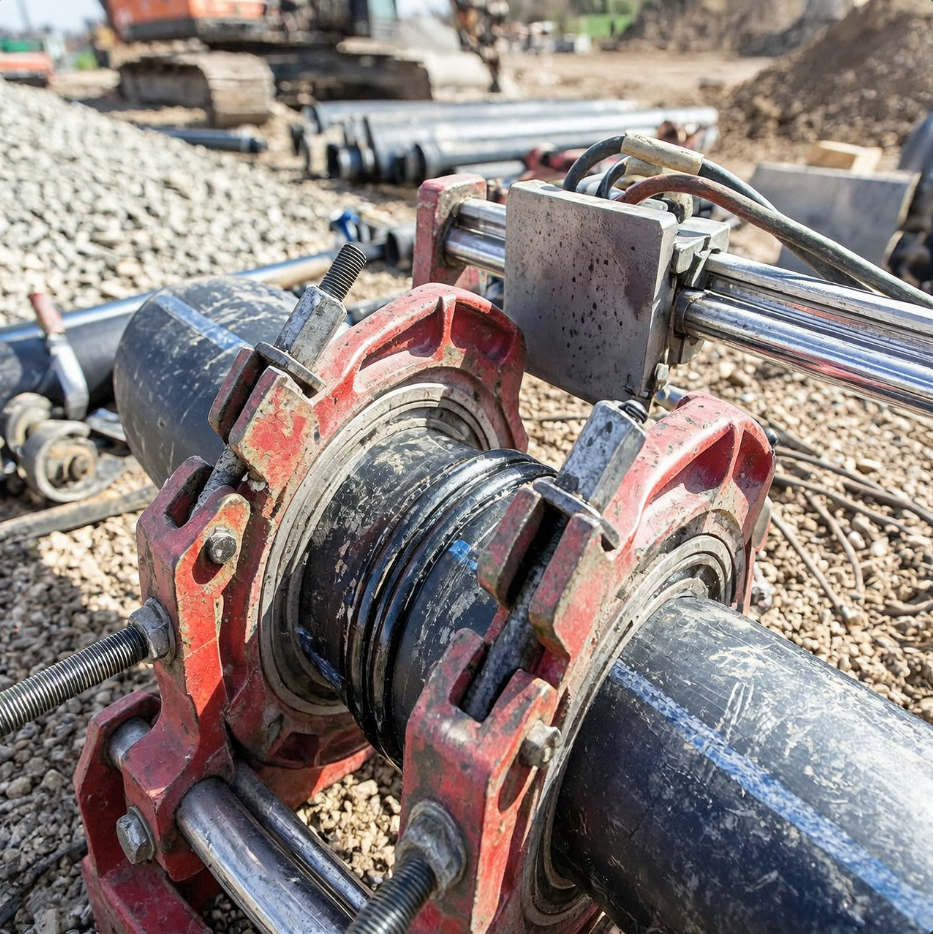
One of the basic technological parameters in butt welding of polyethylene pipes is the value to which the heating element is heated. It determines the degree of plasticisation of the pipe surface and the conditions for its subsequent compaction under pressure. In practice, when working with PE material, a range of approx. 200-220 °C is most often used, which enables a suitable state of heating of the element ends. Too low a value makes it difficult to heat the surface properly and can lead to a joint with an inferior structure. Excessive heating, on the other hand, can cause degradation of the plastic and deterioration of its properties. For this reason, the indication of the device and the stability of maintaining the set temperature on the surface of the hotplate are checked before starting work.
Warm-up time
The length of heating must not be set at random, as it affects the further course of the entire process. The diameter of the pipe and the wall thickness are the main considerations in the selection. The larger the cross-section and the thicker the wall, the more time is needed for the material to reach the appropriate state of plasticisation across the entire face. The parameters for this stage are determined on the basis of process tables and recommendations relating to the specific range of pipe diameters and dimensions.
In the first phase, initial pressure is applied, leading to the formation of a characteristic bump on the circumference of the pipes. Once this has occurred, the pressure is reduced and the ends of the workpieces are left against the heating plate for the time specified for the dimension. This stage must last long enough for the material to reach an adequate state of plasticisation, but without overheating the surface. Too short a time may result in inadequate preparation for joining, while too long a time adversely affects the structure of the plastic and subsequent operations.
Pressure during pipe welding
The pressure is responsible for the contact between the surfaces of the components and influences how the joint is formed. It is not constant - it changes during operation, as different values are applied at the beginning and others when the pipes are joined. A force that is too low will not achieve adequate material bonding, while one that is too high can lead to an incorrectly shaped discharge. The pressure is set and controlled by the welder's hydraulic system. It is important that the subsequent steps are carried out in an appropriate manner and that the pressure values are adapted to the pipe diameter and wall thickness.
Cooktop overrun time
The ends of the pipes must be joined as soon as possible after the hob has been removed. Any delay causes the surface to cool down even before the jointing, which significantly reduces the quality of the joint. Even carefully prepared components will lose the relevant thermal properties if they are not put together immediately. Therefore, the postponement stage requires precision, agility and flawless coordination.
Joint cooling
Once the pipes have been joined, the joint must remain in the clamps until the material has completely stabilised and the forming is complete. During this phase, any adjustments to the position are excluded - the geometric conditions established during the jointing must remain unchanged. The cooling time is strictly dependent on the diameter and wall thickness of the pipe and must therefore not be arbitrarily shortened. Premature removal or displacement risks deforming the shape and reducing the quality of the joint. It is only when the material has fully cooled down that it reaches the strength necessary for safe assembly or transport.
Ambient conditions during welding
The welding process is influenced not only by the setup of the machine and the way the individual steps are carried out, but also by the environment in which the work is carried out. The conditions on the bench can affect the material, the cooling rate and the stability of the whole process, and should therefore not be overlooked when organising the work.
Of particular importance here are factors such as:
- ambient temperature
- wind that causes the material to cool
- precipitation
- direct exposure to the elements
For this reason, the welding station is often covered with a process tent or other protection to limit the impact of external conditions.
Importance of adhering to technological parameters
Welding parameters are not chosen arbitrarily, but result from developed tables and technological recommendations relating to specific diameter ranges and wall thicknesses. Their task is to define the conditions that should be maintained at each stage of work, so that the material is properly prepared and joined in a controlled manner. Deviations from the adopted values may affect the course of the individual phases and lead to a joint of reduced quality.
The durability and tightness of the joint depends on maintaining the right conditions throughout the welding process. It is only by combining all the elements - temperature, time, pressure and ambient conditions - that a reproducible effect and stable properties of the finished joint can be achieved.
FAQ:
What temperature is needed for PE pipe welding?
In butt welding of PE pipes, a hot-plate temperature in the range of approximately 200-220°C is most commonly used. Such a range allows to obtain an adequate state of plasticisation of the surface without the risk of overheating the material. However, the specific value is not universal and should be in accordance with the technological tables for the given range of diameters and wall thicknesses. Before starting work, it is important to check that the machine maintains a stable temperature over the entire surface of the board.
What are the risks if there is too long a delay after heating the pipes?
Once the heating is complete, what matters is that the parts are joined quickly and efficiently. If it takes too long, the surfaces start to cool down and the material no longer retains the right conditions for bonding. This can reduce the strength of the joint and affect its quality. This is why the postponement stage is regarded as one of the more sensitive moments of the entire process.
Does wall thickness affect welding?
Yes, the wall thickness has a direct impact on the welding process. The thicker the wall, the more time it takes for the material to reach the right state before joining. The clamping pressure and cooling length also change. For this reason, the parameters are not the same for all pipes and are always related to specific dimensions.
What mistakes most often spoil the weld?
The most common mistakes include incorrect hotplate temperature, heating time that is too short or too long, and incorrect clamping. Problems also arise with inaccurate preparation of the pipe ends, for example if the surfaces are not level or the components are not aligned. The timing of the plate is also important - operating too slowly can reduce the quality of the joint. Errors can also result from environmental conditions, especially when working outdoors. In practice, even minor deviations at one stage can reduce the final quality of the weld.
Can I choose the welding parameters myself?
Welding parameters should not be chosen arbitrarily. Their values are determined on the basis of technological tables and recommendations relating to specific pipe dimensions and material type. Attempts to set them „by eye” may lead to an incorrect process and a reduction in joint quality. In practice, proven guidelines are used to maintain the repeatability and stability of welds.
